
Express Entry PNP draw invites 752 candidates as cut-off climbs to 772
Immigration, Refugees and Citizenship Canada (IRCC) held Express Entry round #448 on October 13, 2026, a Provincial Nominee Program (PNP) draw that issued invitations to apply (ITAs) for permanent residence to 752 candidates holding a provincial nomination. The lowest-ranked invited candidate had a Comprehensive Ranking System (CRS) score of 772, and the tie-breaking rule was set at July 15, 2026 at 13:57:33. The round was the second-largest of the 20 PNP draws held this year, behind only the 955 invitations issued on June 22. The cut-off was 47 points higher than the 725 recorded in the previous PNP draw on September 28, and the highest for a PNP round since May 25, when it reached 805. Including this round, PNP draws have issued 10,022 invitations in 2026, out of 135,967 issued across all Express Entry draws this year.
10/14/2026
Canada's Permanent Resident Grants Fall 9.7% in First Seven Months of 2026 as Citizenship Mix Shifts
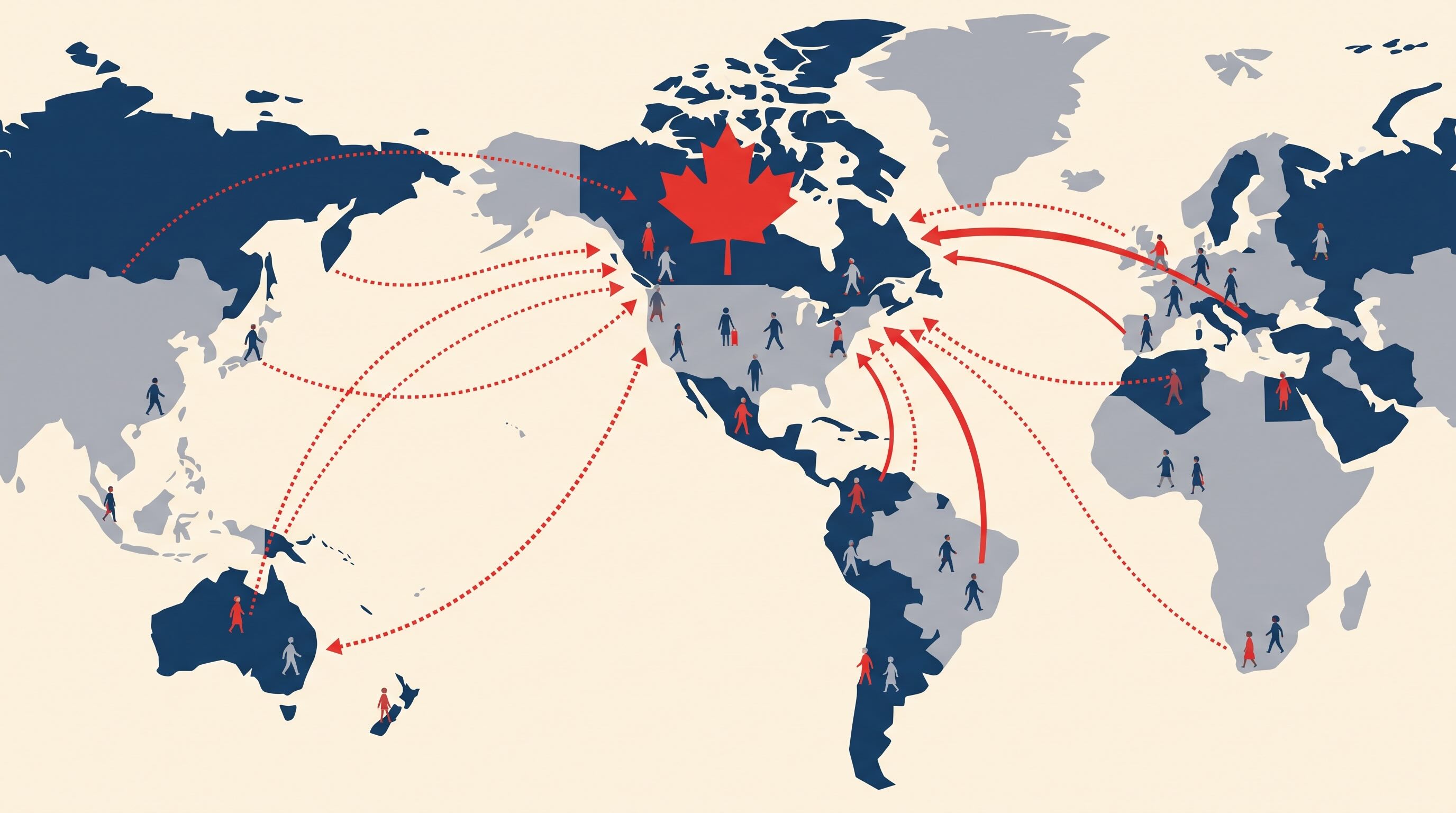
Canada granted permanent resident status to 222,625 people between January and July 2026, according to country-of-citizenship data from Immigration, Refugees and Citizenship Canada (IRCC). That is 23,955 fewer than the 246,580 recorded over the same months of 2025, a year-over-year drop of 9.7%, although the pace of decline has eased since the first half of the year. Beneath the national contraction, outcomes diverged sharply by citizenship. PRs granted to Indian citizens fell by 15,405, a figure equal to 64.3% of the entire national reduction, even as India remained by far the largest country of citizenship. Turkish-citizen PRs jumped 185.2%, and Iran, Nigeria, Sudan, Syria, Uganda and Mexico also recorded strong gains, while France, Eritrea and several North African countries saw steep declines. The Philippines and Pakistan lost a little volume but gained share. The figures describe outcomes only; they are not country quotas and do not change any applicant's eligibility.
10/13/2026
Low-wage LMIA freeze expands to 30 regions as Halifax, Regina and four other CMAs are added
The federal government updated its list of regions where low-wage Labour Market Impact Assessment (LMIA) applications will not be processed on Oct. 9, 2026, adding six census metropolitan areas (CMAs) - Halifax, Fredericton, Kingston, St. Catharines-Niagara, Regina and Lethbridge - after their unemployment rates reached or exceeded 6%, while removing Kamloops and Chilliwack and keeping the 24 previously affected regions in place, which brings the total to 30, up from 26 last quarter. From Oct. 9, 2026 to Jan. 7, 2027, employers in these areas cannot hire new foreign workers, or renew work permits for existing ones, in non-exempt positions paying less than 120% of the provincial or territorial median hourly wage, although agriculture, construction, food manufacturing, hospitals and nursing care facilities are not affected. The measure, in force since Sept. 26, 2024, is one of a series of steps Ottawa has taken to tighten the Temporary Foreign Worker Program (TFWP), and Immigration, Refugees and Citizenship Canada (IRCC) separately extended its concurrent processing window from 60 to 90 days on Aug. 21, 2026, giving foreign workers in Canada with expiring permits more breathing room.
10/10/2026

Ottawa Commits $20 Million to Expand Practice Ready Ontario, Fast-Tracking Up to 200 Internationally Trained Family Physicians
On October 7, 2026, the federal government announced $20 million to expand Practice Ready Ontario (PRO), adding 50 positions a year for four years so that up to 200 internationally trained family physicians can be ready to practise in Ontario by 2028–29, including through a dedicated stream for French-speaking physicians and with a focus on underserved northern, rural and Francophone communities. PRO replaces the traditional two-year residency with a 12-week clinical field assessment, allowing experienced doctors to become licensed in under a year rather than the three to five years typical of other routes. Participants sign a three-year return of service agreement and practise under supervision, earning full independent licensure only after completing that commitment and passing the College of Family Physicians of Canada (CFPC) certification exam. The funding is the latest step in a coordinated federal-provincial push on health workforce shortages: Ottawa has already invited 891 physicians to apply for permanent residence in 2026 through a dedicated Express Entry category, and Ontario now lets doctors and nurses licensed elsewhere in Canada start work within days.
10/09/2026

IRCC Updates Job Offer Genuineness Guidance: Home-Based Businesses Can Support Employer-Specific Work Permits
Immigration, Refugees and Citizenship Canada (IRCC) revised its officer instructions on assessing the genuineness of job offers for employer-specific work permits on September 17, 2026, confirming that home-based businesses can make genuine offers to foreign workers and that a residential address is not, on its own, a reason for doubt. The revised guidance no longer says employers must have a physical location in Canada where the foreign worker will work, and it notes that a business address may differ from where employees actually work. Officers are told to consider all relevant evidence rather than treat any single factor as decisive. At the same time, the instructions state that a company with no employees, existing in name only and set up to facilitate the entry of foreign nationals, is not an operating business. The update also adds a procedural fairness step: an officer with concerns about an offer should send a letter explaining them, and the employer is given 15 days to submit evidence directly to IRCC. Employers must still show that they genuinely conduct business, need the worker they want to hire and can meet the wages and other terms they have offered.
10/08/2026

Ontario Raises Earnings Points Ceiling, Awarding 10 Points to Candidates Earning $80,000 or More
The Ontario Immigrant Nominee Program (OINP) announced on Oct. 7, 2026, that it has added a new top bracket to the scoring grid of the Ontario Workforce Priority Stream (OWPS), awarding 10 points under the "Canadian work experience: earnings history" factor to candidates with annual earnings of $80,000 or more, two points above the previous maximum of 8 points for earnings of $70,000 or more. The change took effect on Oct. 5 and has been applied automatically to affected profiles. Earnings are based on a Notice of Assessment issued by the Canada Revenue Agency (CRA) within the past five years, and higher-scoring candidates stand a better chance of being invited to apply for provincial nomination. Launched on June 26 and opened for intake on Aug. 4, the OWPS is currently Ontario's only provincial nomination route to permanent residence for foreign nationals, while a second phase of the overhaul, adding Priority Healthcare, Entrepreneur and Exceptional Talent streams, still has no launch date.
10/08/2026

Canada holds back-to-back Express Entry draws: CEC cut-off eases to 519, while the senior managers category sets a record low
Immigration, Refugees and Citizenship Canada (IRCC) held Express Entry draws on two consecutive days, September 15 and 16, 2026, issuing invitations to apply (ITAs) to two very different groups of candidates. Round #443, conducted on September 15 at 10:21:41 UTC, issued 2,000 invitations under the Canadian Experience Class (CEC) with a minimum Comprehensive Ranking System (CRS) score of 519 and a tie-breaking rule of March 26, 2026 at 00:16:39 UTC; round #444, held the following day at 12:44:28 UTC, issued 250 invitations under the category for senior managers with Canadian work experience at a minimum CRS score of just 389, with a tie-breaking rule of September 1, 2026 at 23:05:13 UTC. Both rounds were authorized by ministerial instructions signed in Ottawa by Immigration Minister Lena Metlege Diab under the Immigration and Refugee Protection Act (IRPA). The senior managers category, created in February 2026, has now run three draws, with the cut-off falling from 429 in its first round to 392 and then 389 -- a cumulative drop of 40 points and the lowest threshold in the category's short history. Over the same period, the CEC cut-off has declined for a third consecutive round after peaking at a 2026 high of 523 on August 18. Through round #444, IRCC has held 56 draws and issued 128,982 invitations in 2026, an annual record since Express Entry was launched.
09/18/2026

Express Entry round #442 issues 576 PNP invitations as the cut-off climbs back to 734
Immigration, Refugees and Citizenship Canada (IRCC) held the 442nd Express Entry round on September 14, 2026, issuing 576 invitations to apply (ITAs) for permanent residence to candidates in the Provincial Nominee Program (PNP) category with a minimum Comprehensive Ranking System (CRS) score of 734, up 37 points from the 697 recorded on August 31, the lowest PNP cut-off of the year, while the size of the round edged past the 562 invitations issued two weeks earlier to make it the second-largest PNP round since June 22. The ministerial instruction behind the round was signed in Ottawa by Immigration Minister Lena Metlege Diab, and the tie-breaking rule was set at 21:39:50 UTC on August 29, 2026, barely two weeks before the draw itself, a sign that a substantial share of the candidates sitting exactly at 734 were recently nominated applicants who had only just entered the pool. With this round, IRCC has held 54 Express Entry draws in 2026 and issued 126,732 invitations in total, including 18 PNP rounds accounting for 8,537 invitations, 22.8 percent more than the 6,947 issued over the same period in 2025 and consistent with Ottawa's decision to restore the 2026 provincial nominee admissions target to 91,500. A pool snapshot published the day before the draw showed 226,793 candidates in the pool, of whom roughly 574 scored 601 or higher, almost exactly matching the 576 invitations issued, which means IRCC once again cleared out nearly the entire top tier of nominated candidates in a single round. Analysts expect the remaining PNP rounds this year to keep to a roughly biweekly rhythm of a little over 400 invitations each, with the cut-off driven largely by how quickly the provinces feed new nominations into the federal pool.
09/15/2026

Canada Restores Study-Permit Exemption for Work Permit Holders, in Force Until the End of 2027
Immigration, Refugees and Citizenship Canada (IRCC) announced a temporary public policy on September 9, 2026 that allows foreign nationals holding a valid work permit to enrol in a course of six months or less without applying for a study permit, even if the course ends after the period of stay authorized on their first entry to Canada. Signed by Minister of Citizenship and Immigration Lena Metlege Diab on August 5, the policy took effect on September 4, runs until December 31, 2027, and may be revoked at any time. It revives a measure of the same name introduced in June 2023 that expired on June 27 of this year, but with a narrower reach: the earlier policy let eligible workers, including those on maintained status, study programs of any length without a study permit, whereas the new one requires applicants to hold a valid work permit and waives only the requirement that a course be completed within the initial authorized period of stay. As of June 30, 2026, roughly 1.55 million foreign nationals in Canada held a work permit only, and about 630,000 held a study permit. IRCC says the measure is intended to help workers already in the country, such as tradespeople, nurses and laboratory technicians, upgrade their skills and credentials to fill gaps in critical sectors, and that it does not change the government's overall target of reducing temporary residents to less than 5 percent of the population.
09/10/2026

Canada raises study permit proof-of-funds threshold to $23,448, and tightens scrutiny of where the money comes from
Immigration, Refugees and Citizenship Canada (IRCC) has raised the study permit proof-of-funds requirement as of September 1, 2026, with a single applicant studying outside Quebec now required to show at least $23,448 CAD for a first year of living expenses, up $553 from the previous $22,895, and with the thresholds for larger families rising in step. Alongside the higher dollar figures, IRCC has updated its guidance to make clear that officers will assess not only how much money an applicant has but where it came from and whether it will remain available throughout the period of study, with applicants expected to supply six months of bank statements and documents explaining the source of the deposits shown in them; those enrolled in programs longer than one year must also set out how they intend to pay for the remaining years. The threshold covers living costs only, meaning tuition and round-trip transportation must be demonstrated separately, and Quebec continues to apply its own financial capacity standard through the CAQ, set at $24,617 for a single applicant. The increase extends a policy direction Canada has followed since 2024, combining sharply higher financial requirements with a shrinking study permit cap, which falls to 408,000 for 2026, a 7% reduction from 2025.
09/08/2026