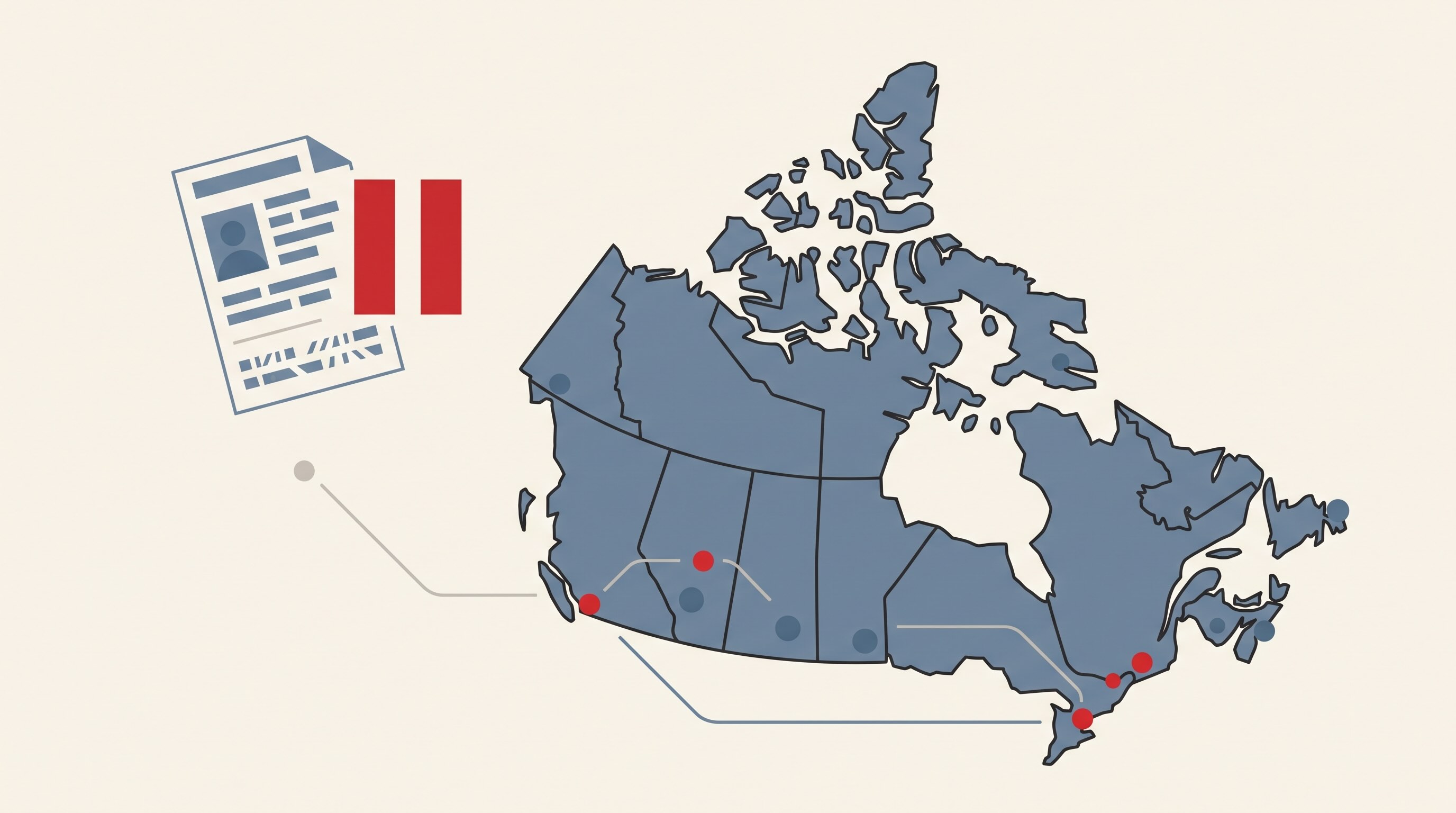
Employment and Social Development Canada (ESDC) updated its official web page on Oct. 9 to publish the latest quarterly list of regions where low-wage LMIAs will not be processed. Under the rules, ESDC will refuse to process LMIA applications submitted under the TFWP's low-wage stream when the job is located in a CMA with an unemployment rate of 6% or higher and the hourly wage offered is below 120% of the provincial or territorial median. The new list applies from Oct. 9, 2026 to Jan. 7, 2027, and the next update is scheduled for Jan. 8, 2027.
List changes: six regions added, two removed
The six CMAs newly subject to the freeze this quarter are spread across Atlantic Canada, Ontario and the Prairies:
- Halifax (Nova Scotia): unemployment rate of 6.1%
- Fredericton (New Brunswick): unemployment rate of 6.2%
- Kingston (Ontario): unemployment rate of 6.3%
- St. Catharines-Niagara (Ontario): unemployment rate of 6.5%
- Regina (Saskatchewan): unemployment rate of 6.7%
- Lethbridge (Alberta): unemployment rate of 6.0%
Notably, Halifax and Regina had only just regained access to low-wage LMIA processing in the July 2026 update, and St. Catharines-Niagara's unemployment rate had at that point fallen from 7.2% to 5.8%. All three are back under restrictions just one quarter later. Meanwhile, Kamloops and Chilliwack in British Columbia, which were added to the list in July after their unemployment rates rose to 7.0% and 7.9% respectively, have both been removed this quarter.
Over the past year, the number of affected regions first declined and then climbed again:
- October 2025: 32
- April 2026: 30
- July 2026: 26
- October 2026: 30
Affected regions
The following 30 CMAs, listed with their unemployment rates, are ineligible for low-wage LMIA processing from Oct. 9, 2026 to Jan. 7, 2027:
| Census metropolitan area (CMA) | Province | Unemployment rate (%) |
|---|---|---|
| St. John's | Newfoundland and Labrador | 6.4 |
| Halifax (new) | Nova Scotia | 6.1 |
| Moncton | New Brunswick | 8.1 |
| Fredericton (new) | New Brunswick | 6.2 |
| Montréal | Quebec | 7.2 |
| Ottawa-Gatineau | Ontario/Quebec | 7.9 |
| Kingston (new) | Ontario | 6.3 |
| Belleville - Quinte West | Ontario | 6.4 |
| Peterborough | Ontario | 6.3 |
| Oshawa | Ontario | 9.8 |
| Toronto | Ontario | 7.5 |
| Hamilton | Ontario | 7.4 |
| St. Catharines-Niagara (new) | Ontario | 6.5 |
| Kitchener-Cambridge-Waterloo | Ontario | 7.6 |
| Brantford | Ontario | 6.3 |
| Guelph | Ontario | 7.5 |
| London | Ontario | 9.1 |
| Windsor | Ontario | 7.9 |
| Barrie | Ontario | 6.2 |
| Greater Sudbury | Ontario | 6.2 |
| Regina (new) | Saskatchewan | 6.7 |
| Saskatoon | Saskatchewan | 6.5 |
| Lethbridge (new) | Alberta | 6.0 |
| Calgary | Alberta | 6.4 |
| Red Deer | Alberta | 6.9 |
| Edmonton | Alberta | 7.6 |
| Kelowna | British Columbia | 8.6 |
| Abbotsford-Mission | British Columbia | 7.6 |
| Vancouver | British Columbia | 7.0 |
| Nanaimo | British Columbia | 6.6 |
Oshawa, Ont., has the highest unemployment rate on the list at 9.8%, followed by London (9.1%) and Kelowna, B.C. (8.6%). Ontario accounts for 15 of the listed CMAs (including Ottawa-Gatineau), making it the province with the largest concentration of affected regions.
In Montréal, even though the city's unemployment rate briefly dipped below 6% in early 2026, a separate pause imposed by the Quebec government means low-wage LMIA applications for jobs in the Montréal and Laval administrative regions will not be accepted until Dec. 31, 2026. Jobs located in a census agglomeration (CA) rather than a CMA are not subject to the processing freeze.
Wage thresholds: set at 120% of the provincial median
Whether a position falls under the high-wage or low-wage stream depends on whether the hourly wage offered by the employer meets the threshold for the province or territory where the job is located. The current thresholds are based on data from the federal government's Job Bank and apply to LMIA applications received on or after July 17, 2026:
| Province/Territory | Low-wage threshold (hourly) |
|---|---|
| Alberta | $37.50 |
| British Columbia | $38.40 |
| Manitoba | $31.33 |
| New Brunswick | $31.73 |
| Newfoundland and Labrador | $33.60 |
| Northwest Territories | $48.00 |
| Nova Scotia | $31.96 |
| Nunavut | $45.00 |
| Ontario | $36.92 |
| Prince Edward Island | $31.20 |
| Quebec | $36.00 |
| Saskatchewan | $34.62 |
| Yukon | $45.60 |
Compared with the previous thresholds, the latest figures are higher across the board. For example:
- British Columbia: up from $36.60 to $38.40
- Alberta: up from $36.00 to $37.50
- Ontario: up from $36.00 to $36.92
- Quebec: up from $34.62 to $36.00
- Nova Scotia: up from $30.00 to $31.96
As a result, some positions that previously qualified for the high-wage stream may now fall into the low-wage stream if pay stays the same, which would make them ineligible for processing in affected regions.
Exemptions
Positions in the following sectors are not affected by the freeze:
- Primary agriculture
- Construction
- Food manufacturing
- Hospitals
- Nursing and residential care facilities
Private households hiring nurses, child care providers or personal support workers as in-home caregivers are also exempt. For temporary, highly mobile work such as concerts, carnivals and fairs, employers may also request an exemption on a case-by-case basis.
Background
The federal government announced restrictions on the low-wage stream in August 2024, and beginning Sept. 26, 2024, stopped processing low-wage LMIA applications in CMAs with unemployment rates of 6% or higher, updating the list of affected regions every quarter since. On Nov. 8, 2024, the low-wage threshold was raised from the provincial median wage to 120% of the median.
As part of the same round of tightening, the cap on the share of low-wage foreign workers an employer can hire at a single work location was lowered from 20% to 10%, and the federal government also set annual arrival targets for temporary residents. Data show TFWP arrivals in 2026 are down more than 50% from 2024, and the government plans to admit about 60,000 TFWP work permit holders this year.
LMIAs and work permit renewals
An LMIA is an official document confirming that an employer was unable to find a qualified Canadian citizen or permanent resident (PR) to fill the position. Under TFWP rules, a foreign national applying for or renewing a work permit generally needs a Canadian employer to first obtain a positive or neutral LMIA. ESDC issues the LMIA to the employer, and the foreign worker then includes it with a work permit application submitted to IRCC.
Foreign workers already in Canada whose work permits are about to expire may, if they meet certain conditions, ask to have their work permit application processed concurrently with their employer's LMIA application. On Aug. 21, 2026, IRCC extended the concurrent processing window from 60 to 90 days, meaning it will hold an application for up to 90 days after receipt while awaiting the LMIA outcome before making a final decision. Concurrent processing typically requires that:
- The applicant's current work permit expires within two weeks
- The employer has submitted a complete LMIA application
- The applicant provides the LMIA result to IRCC within 90 days
In addition, foreign workers who apply for an extension before their current work permit expires have maintained status: as long as they remain in Canada, they can keep working under the conditions of their existing permit until a decision is made on the new application.