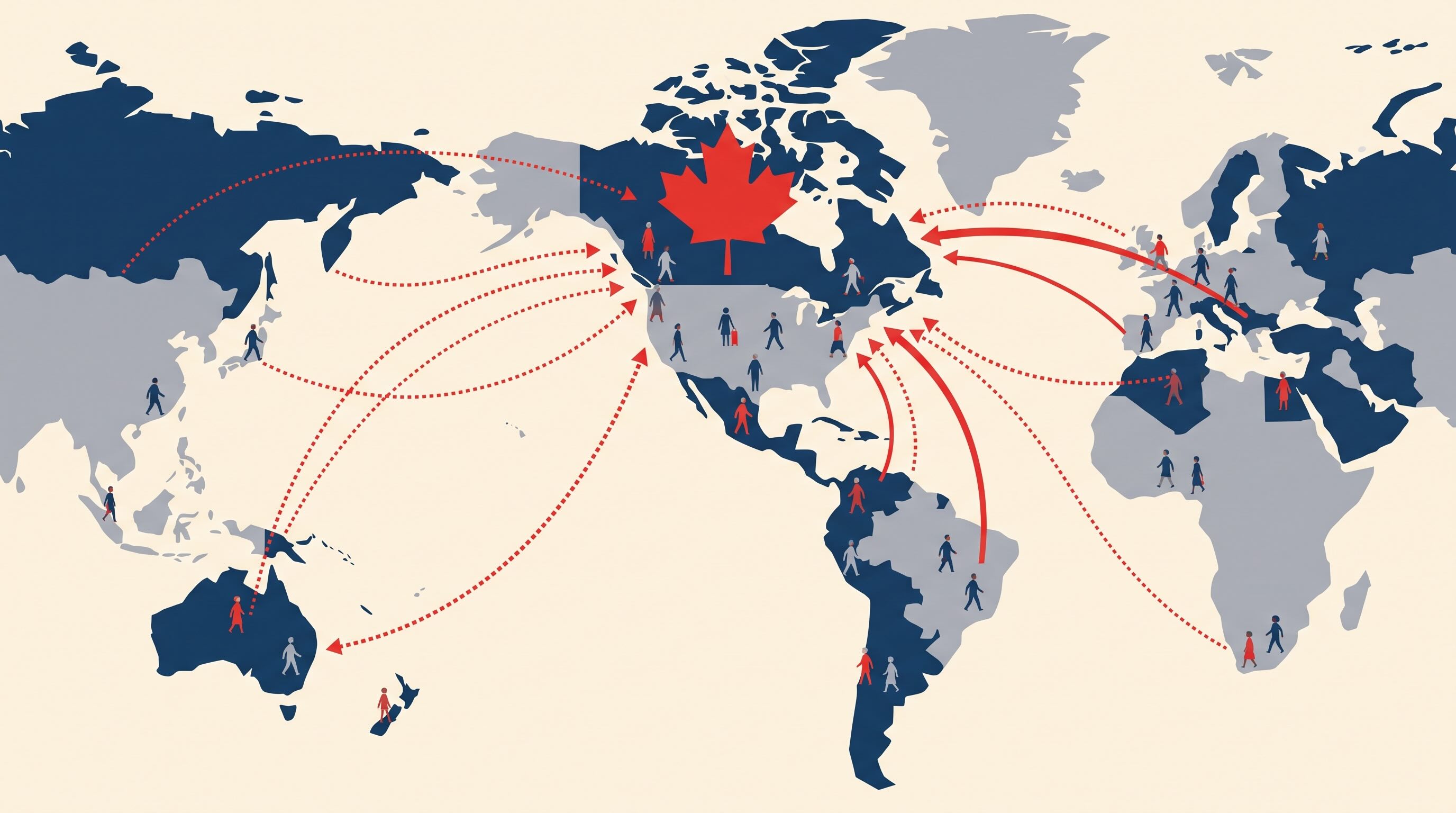
Key numbers from round #440
According to Ministerial Instructions No. 440, signed by IRCC on September 3, the round was conducted that day at 11:18:08 UTC and was open only to the Physicians with Canadian Work Experience category (2026, version 1). The results were as follows:
- Invitations issued: 229
- Rank required to be invited: within the top 229 candidates in the category grouping
- Minimum CRS score: 198
- Tie-breaking rule: August 6, 2026 at 19:40:38 UTC — where several candidates sit exactly at the cut-off score, priority goes to those who submitted their Express Entry profile before that timestamp
- Invitation window: September 3 to September 4, 2026
- Programs covered: candidates under the Federal Skilled Worker Program (FSWP), the Canadian Experience Class (CEC) and the Federal Skilled Trades Program (FSTP) were all eligible to be invited in this round
The instructions were signed by Minister of Citizenship and Immigration Lena Metlege Diab, with legal authority drawn from paragraphs 10.3(1)(h.1)(iii) and 10.3(1)(h.2) to (j) and subsection 10.3(1.1) of the Immigration and Refugee Protection Act (IRPA). The instructions state that the economic goal the category is intended to support is to "contribute to Canada's long-term economic success by retaining top talent with Canadian work experience."
Who qualifies for the category
Under section 3 of the instructions, an Express Entry candidate must meet all of the following conditions to be placed in the physicians category grouping and ranked within it:
- Have accumulated, within the past three years, at least one year of full-time work experience in Canada (or the equivalent in part-time work) in an occupation falling under one of these three National Occupational Classification (NOC) unit groups:
- NOC 31100: Specialists in clinical and laboratory medicine
- NOC 31101: Specialists in surgery
- NOC 31102: General practitioners and family physicians
- Have performed, during that period of employment, the actions described in the lead statement of the occupational description in the NOC for that occupation;
- Have performed, during that period of employment, a substantial number of the main duties of the occupation, including all of the essential duties.
Section 4 of the instructions makes a point of excluding any period of unauthorized work in Canada from that experience calculation. The definitions of "full-time work" and "work" follow subsections 73(1) and 73(2) of the Immigration and Refugee Protection Regulations — that is, paid work of at least 30 hours per week.
It is worth noting that the physicians category and the healthcare and social services occupations category carried over from 2025 overlap in occupational terms — the latter also covers NOC 31100 through 31102 — but their thresholds differ. The healthcare and social services category accepts work experience gained either inside or outside Canada, while the physicians category expressly requires that the year of experience be obtained in Canada. IRCC's official page also reminds candidates that they must still meet the basic requirements of one of the three Express Entry programs and hold a licence to practise medicine in the relevant province or territory.
Three draws: falling invitation counts, consistently low cut-offs
The physicians category was announced by IRCC on December 8, 2025 and formally added to the annual category framework on February 18, 2026. Since February, IRCC has run three rounds for the category:
| Round | Date | ITAs issued | Minimum CRS score |
|---|---|---|---|
| Round #397 | February 19, 2026 | 391 | 169 |
| Round #421 | June 24, 2026 | 271 | 223 |
| Round #440 | September 3, 2026 | 229 | 198 |
| Total | — | 891 | — |
The 229 invitations issued this time are the fewest of the three rounds, while the 198-point cut-off sits in the middle of the range — below June's 223 but above the 169 set in the inaugural February round. None of the three rounds has topped 230 points, whereas general CEC rounds in 2026 have consistently ranged between 507 and 523 points, and PNP-specific rounds, which carry an extra 600 CRS points for a provincial nomination, have generally run between 697 and 805. In other words, eligible physicians barely need to compete with other candidates on the usual CRS dimensions such as language and age.
Immigration information services including Moving2Canada read the decline from 391 to 271 and then to 229 invitations as a sign that IRCC has been "draining" the eligible candidates present in the pool with each successive round, leaving fewer people left to invite; for physicians who meet the one-year Canadian practice requirement, a cut-off this low means an invitation is relatively easy to secure. immigration.ca takes a similar view, arguing that the category was always aimed at "a small group of candidates already working in Canada," so a cut-off far below the general rounds is only to be expected, alongside a falling invitation count and scores that fluctuate within a narrow band. CIC News summarized this round as the category's draw with the lowest invitation count and the second-highest cut-off.
Law firms caution, however, that a cut-off is ultimately a function of how many candidates are in the pool in a given round and how they rank, and that no category can guarantee a particular score. They also point out that job offers have not counted toward CRS points since March 25, 2025, and that since August 21, 2025 invited candidates must complete their medical exams upfront — applicants should not treat Express Entry as a simple form-filling exercise.
Recent draw cadence
This round continues the rotation of "PNP, CEC, French-language or category-based" draws that IRCC has followed since August. Of the ten rounds held between August 4 and September 3, the physicians draw was joined by three PNP rounds (507, 442 and 562 ITAs at 768, 760 and 697 points), three CEC rounds (3,000, 1,000 and 2,000 ITAs at 516, 523 and 521 points), two French-language proficiency rounds (5,000 ITAs each, at 391 and 382 points) and one transport occupations round (300 ITAs at 470 points). The 523-point CEC cut-off on August 18 was the highest for that category in 2026.
| Round | Date | Category | ITAs issued | Minimum CRS score |
|---|---|---|---|---|
| Round #431 | August 4 | Provincial Nominee Program (PNP) | 507 | 768 |
| Round #432 | August 5 | Canadian Experience Class (CEC) | 3,000 | 516 |
| Round #433 | August 6 | French-language proficiency | 5,000 | 391 |
| Round #434 | August 7 | Transport occupations | 300 | 470 |
| Round #435 | August 17 | Provincial Nominee Program (PNP) | 442 | 760 |
| Round #436 | August 18 | Canadian Experience Class (CEC) | 1,000 | 523 |
| Round #437 | August 19 | French-language proficiency | 5,000 | 382 |
| Round #438 | August 31 | Provincial Nominee Program (PNP) | 562 | 697 |
| Round #439 | September 1 | Canadian Experience Class (CEC) | 2,000 | 521 |
| Round #440 | September 3 | Physicians with Canadian work experience | 229 | 198 |
As of September 3, IRCC has held 52 Express Entry rounds in 2026 and issued 122,656 invitations, having already broken the annual record of 114,431 set in 2021 back on August 18. By category, the CEC leads with 51,250 ITAs, followed closely by French-language proficiency at 50,500, healthcare and social services at 8,000 (4,000 each on February 20 and June 25, at cut-offs of 467 and 475), the Provincial Nominee Program at 7,961, trades occupations at 3,000, physicians at 891, senior managers at 750, transport occupations at 300 and skilled military recruits at 4. The physicians category's overall volume is modest, but measured by the number of rounds held it has been the most frequently drawn occupation-targeted category of 2026 apart from the French-language stream.
Policy background: from doctor shortage to a dedicated stream
The physicians category traces back to December 8, 2025. That day, Minister Diab announced three immigration measures aimed at doctors: first, a dedicated physicians category within Express Entry, requiring at least 12 months of full-time (or equivalent part-time) medical practice in Canada within the past three years; second, up to 5,000 additional federal allocations set aside for provinces and territories, over and above their regular provincial nominee quotas, specifically for nominating licensed physicians who hold a job offer; and third, 14-day expedited processing of work permit applications for physicians who receive a provincial nomination. Diab said at the time, "This dedicated Express Entry category will help bring in and keep practice-ready doctors, so people across Canada can get the care they need."
On February 18, 2026, unveiling the 2026 Express Entry category framework in Toronto, Diab listed foreign physicians with Canadian work experience as one of four new categories, alongside researchers and senior managers with Canadian work experience, transport occupations and highly skilled military recruits. The healthcare and social services, trades and French-language proficiency categories were retained, while the agriculture and agri-food category was discontinued. In her remarks, Diab stressed that "providing a clear pathway to permanent residence helps keep doctors in Canada and supports better access to care."
Underpinning the policy is Canada's long-running primary care gap. Figures cited by IRCC show that in 2024 roughly 5.7 million adults (17 per cent) and 765,000 children and youth (11 per cent) had no regular healthcare provider; a survey released by the Canadian Medical Association (CMA) and OurCare in December 2025 found that about 5.9 million Canadian adults still lacked a regular primary care provider, although that figure had improved from 6.5 million in 2022. The Globe and Mail has reported that Canada is short roughly 23,000 family doctors, while more than 13,000 internationally trained physicians in the country are unable to work in their field. IRCC data also show that 31 per cent of Canada's family doctors were internationally trained in 2024, and that more than 11,000 healthcare workers arrived through economic immigration that year.
The CMA welcomed the federal measures as "a step in the right direction," but noted that immigration policy has to be paired with expanded licensing pathways to make a real difference. Practitioners echo the point: immigration lawyers caution that permanent residence does not itself confer the right to practise medicine, and that the immigration process runs independently of licensing by provincial colleges (such as Ontario's CPSO) and the Medical Council of Canada (MCC). Others worry about the consequences if residency training and licensing remain too difficult: "As soon as the word starts to spread that you can get people here but staying here is difficult, I think people are going to reconsider."
What it means for applicants
For international medical graduates and foreign-trained doctors already practising in Canada who have accumulated a year of full-time (or equivalent part-time) physician work experience within the past three years, the physicians category offers one of the lowest-threshold routes to an invitation currently available in Express Entry. All three rounds have closed below 230 points, which means a candidate who simply meets the category requirements and sits in the pool stands a strong chance of being invited. Combined with the cadence IRCC has kept in 2026 — roughly one physicians round every three to four months (February, June, September) — doctors who have yet to enter the pool, or whose work experience is about to reach the one-year mark, can plan their profile submission accordingly.
Several caveats apply. First, periods of unauthorized work do not count toward the experience requirement. Second, invited candidates must submit a complete permanent residence application within the prescribed deadline and complete their medical exams upfront under the rules that took effect in August 2025. Third, immigration status and a medical licence run on two parallel tracks, and applicants should check the requirements of the medical regulator in their province or territory in parallel. Under the 2026-2028 Immigration Levels Plan, the federal high-skilled stream — that is, the three Express Entry programs — has an admissions target of 109,000 for 2026, and Diab has said the department will "continue to prioritize foreign nationals already living and working in Canada." The continuing physicians rounds are an expression of exactly that priority.